
CLICK PICTURE-ON NEW TAB -TO GET BIGGER VIEW

THESE ARE THE OUTSIDE POWERS BROUGHT TO CHINA [BY BRITISH]TO DEFEAT CHINA
british opium and drug trade 1840 to 1920
ALSO READ:-‘Opium profits funded many banks, insurance, and shipping firms in Bombay and Calcutta:http://interestingnewsfromallover.blogspot.in/2012/10/opium-profits-funded-many-banks.html
========================================================================
In 1711, the Company established a trading post in Canton (Guangzhou), China,
========================================================================
In 1711, the Company established a trading post in Canton (Guangzhou), China,
 | |||||||||||||||||||||||||||||||
THE OPIUM MONOPOLY[forcible sale of opium drugs made in India to china by the British east India company] In 1729, when the foreign import was 200 chests, the Emperor Yung Ching  issued the first anti-opium edict, enacting severe penalties on the sale of opium and the opening of opium-smoking divans. The importation, however, continued to increase, and by 1790 it amounted to over 4,000 chests annually. In 1796 opium smoking was again prohibited, and in 1800 the importation of foreign opium was again declared illegal. Opium was now contraband, but the fact had no effect on the quantity introduced into the country, which rose to 5,000 chests in 1820; 16,000 chests in 1830; 20,000 chests in 1838, and 70,000 chests in 1858." The Chinese had repeatedly appealed to the British Government to stop these imports, but the British Government had turned a persistently deaf ear. Emperor determined to deal with the matter on his own account. He sent a powerful official named Lin to attend to it, and Lin had a sort of Boston Tea Party and destroyed some twenty thousand chests of opium in a very drastic way. Mr. H. Wells Williams describes it thus: "The opium was destroyed in the most thorough manner, by mixing it in parcels Of 200 chests, in trenches, with lime and salt water, and then drawing off the contents into an adjacent creek at low tide."  Lin Zexu-A Chinese artist's drawing of Lin (published 1843)  A painting of Lin supervising the destruction of opium After this atrocity, followed the first Opium War, when British ships sailed up the river, seized port after port, BRITISH DRUG PUSHERS IN CHINA – THE FIRST OPIUM WAR The Nemesis destroying Chinese war junks during the Second Battle of Chuenpee, 7 January 1841 and bombarded and took Canton. Her ships sailed up the Yangtsze, and captured the tribute junks  Engagement between British and Chinese ships in the First Battle of Chuenpee, 1839 going up the Grand Canal with revenue to Peking, thus stopping a great part of China's income. Peace was concluded in 1843, and Great Britain came out well. She recompensed herself by taking the island of Hongkong; an indemnity Of 21 million dollars, and Canton, Amoy,  British troops in the Battle of Amoy, 1841 Foochow, Ningpo  British troops capture Chinkiang in the last major battle of the war, 21 July 1842 and Shanghai were opened up as "treaty ports"-for the importation of opium and the "open-door" in general. forcing the weaker to pay for opium within its borders against all its laws, thus paralyzing the little moral power its feeble government could exert to protect its subjects. . . . It was a turning point in the national life of the Chinese race, but the compulsory payment of six million dollars for the opium destroyed has left a stigma upon the English name."  Signing of the Treaty of Nanking (1842).  Entrance of the Opium War Museum inGuangdong, China Within fifteen years after this first war, there was another one, and again Great Britain came off victorious.  Pa-Li-Kiao's bridge, on the evening of the battle, by Émile Bayard-
 The execution of the Paris Foreign Missions Society missionary Auguste Chapdelaine was the official cause of the French involvement in the Second Opium War.  Cousin-Montauban leading French forces during the 1860 campaign.  Combat at Guangzhou (Canton) during the Second Opium War . By the terms of the Treaty of Tientsin, the sale of opium in China was legalized in 1858.  Chinese officers hauling down the British flag and arresting the crew of the Arrow  Looting of the Yuan Ming Yuan by Anglo-French forces in 1860.  the New Summer Palace, just before its destruction by Anglo-French troops.  Signing of the Treaty of Tientsin in 1859-06-06 after China lost the war .  US marines Japanese infantry German marines  City, 20 November 1900     The Eight-Nation Alliance with their naval flags. Japanese print, 1900  
👈Russian officers.  Cavalry of the British Indian Army,  Qing Armies fighting the Eight-Nation Alliance (British and Japanese soldiers depicted)   JARDINE, MATHESON AND CO. On 1 July 1832, Jardine, Matheson and Company, a partnership, between William Jardine, James Matheson as senior partners, The firms operations included smuggling opium into China from Malwa, India, trading spices and sugar with thePhilippines, exporting Chinese tea and silk to England, factoring and insuring cargo, renting out dockyard facilities and warehouse space, trade financing and other numerous lines of business and trade. In 1834, Parliament ended the monopoly of the British East India Company on trade between Britain and China. Jardine, Matheson and Company took this opportunity to fill the vacuum left by the East India Company. With its first voyage carrying tea, the Jardine clipper ship "Sarah" left for England.  Jardine Matheson then began its transformation from a major commercial agent of the East India Company into the largest British trading hong (洋行), or firm, in Asia   OPIUM TRADE    OPIUM ADDICTS  Licensable China and the Opium Wars. From left images of an advertisement for heroin, a woodcut depicting an addict seloling his wife for drugs and a heroin den. A bargain was then made between China and Great Britain, in 1907, China agreeing to diminish poppy cultivation year by year for a period of ten years, and Great Britain agreeing to a proportional decrease in the imports of Indian opium. A three years' test was first agreed to, a trial of China's sincerity and ability, for Great Britain feared that this was but a ruse to cut off Indian opium, while leaving China's opium alone in the field. At the end of three years, however, China had proved her ability to cope with the situation. Thus, for a period of ten years, both countries have lived up to their bargain, the amount of native and foreign opium declining steadily in a decreasing scale. April 1, 1917, saw the end of the accomplishment. The year 1917 saw a tremendous blow dealt to the British opium dealers, but other markets will be found. There are other countries than China whose inhabitants can be taught this vice   'Opium accounted for a large part of India's economy' Photo courtesy: Wellcome Library
  GUNBOAT DIPLOMACY & THE TREATY OF NANKING Shanghai (the first of the “treaty ports”). 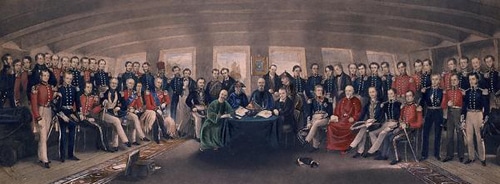 "...and finally, you must stop staring at our huge noses and calling us smelly Barbarians."
 1860 hongkong victoria harbor 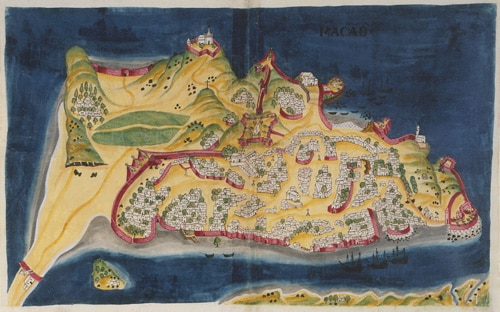 Map of Macau, 1635   canton china painting  queens road from canton bazar   Jejeebhoy and his Chinese secretary (portrait by George Chinnery) Born on 15 th. July 1783, in Mumbai (then Bombay) to a poor weaver . n all Jamsetjee made five voyages to China and back, between the ages of sixteen and twenty-four, becoming immensely rich, well known and highly respected, all by the tender age of twenty-four years.
| |||||||||||||||||||||||||||||||


